

Architects are trained to think in decades. We design buildings to stand for fifty years, master plans that run twenty, and maintenance strategies that outlast the original owner. Then many of us run our own firms as if the lease expires next Tuesday.
Ask a principal at a small or mid-sized firm about their exit plan, and you'll usually get one of three answers: "I'm not there yet," "One of my senior people will probably take it over," or a long pause followed by something about a lake house. All three amount to the same plan: keep working until you stop, then close up.
That works fine, but you're leaving a lot on the table.
The Numbers Aren't Flattering
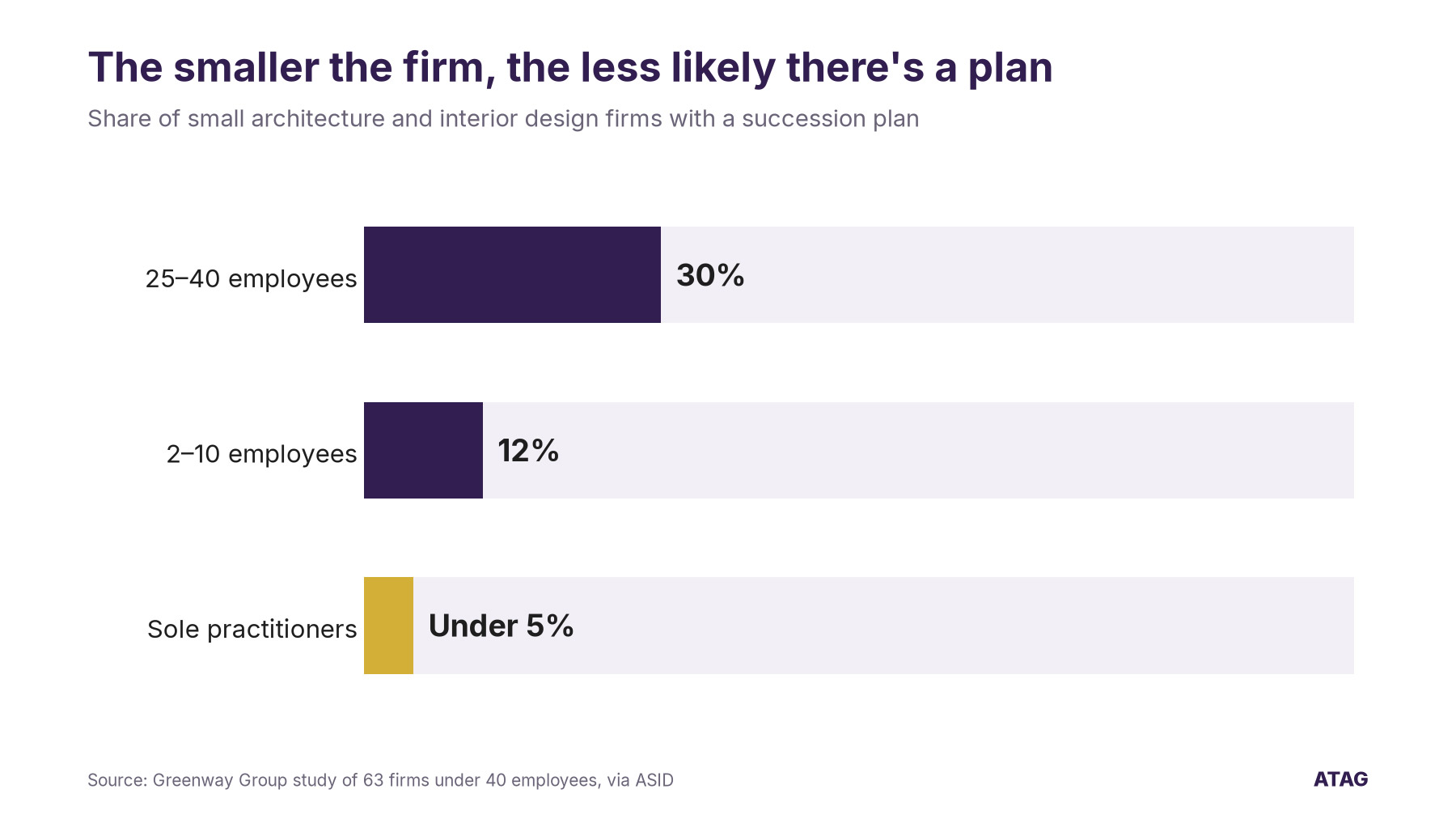
The design industry knows this is a problem, and smaller firms feel it most. A Greenway Group study of architecture and interior design firms with fewer than 40 employees found that only 30% of firms with 25–40 people had a succession plan. For firms with 2–10 people, the number was 12%, and for sole practitioners it was under 5%. Across AEC more broadly, the ACEC/FMI ownership transition survey found that only 51% of firms with fewer than 50 employees have a formal ownership transfer plan, compared with 89% of firms with 200 or more.
Wanting an internal handoff doesn't mean one is possible. PSMJ reports that in about four out of five of its transition assignments, the owner wants to sell internally and then learns they can't. Usually the obstacle isn't a lack of talent. Nobody was developed, financed, or given the authority to buy in.
Why Architects Default to Closing
Most architecture firms aren't built to be sold. They're built around a person.
The clients hired the principal. The reputation belongs to the principal. The pipeline lives in the principal's phone and memory, and the firm's brand is often the principal's last name. When that person leaves, a buyer or successor has to ask what's left beyond the furniture and a server full of CAD files. The AIA Trust heard the same concern from advisors: when a sole owner never broadens the bench, the younger talent has often left by the time retirement arrives, and there isn't much left once the "main man or woman" walks out.
That's a strategy problem, not a valuation problem. It's also why the closing-shop default costs so much. Principals spend thirty years building a business and then treat it like a job they're retiring from.
Selling a Business is a Project, Not an Event
I learned this before I ever applied it to architecture. Starting around 2011, I began selling my family’s company in a deal valued at multi-millions of dollars. We sold the majority stake up front, kept about a third, and I stayed on under a two-year agreement before fully exiting in 2015. It wasn't smooth, and it taught me three things I now bring to every conversation about exits.
We were shopping for a buyer when we should have been looking for a partner. If you're selling 100% and walking away, maybe the highest bidder is good enough. We still owned a third of a multi-million-dollar company, so its future value was our money too. We spent far more energy on whether the deal closed than on who would run the company afterward. The new owner-manager brought outside capital, a few years of management experience, and a command-and-control style that was the opposite of ours. We had been an open-door company where anyone could raise an idea and pitch in on any job. Suddenly senior people were hearing phrases like "direct order" and "need to know." Several mid-level leaders resigned almost immediately. Nobody had done anything wrong exactly. The fit was just never evaluated.
Golden handcuffs work, mostly. We gave key employees incentives to stay through the transition, and for most of them it worked. It almost certainly helped the valuation too, because buyers pay more when the people who generate the revenue are committed to staying.
Incentives don't fix politics. One of our best salespeople also had golden handcuffs, but he believed he deserved a bigger role in the deal and an ownership stake. He was very good at internal politics, and he used it. He drove a wedge between my father, the outgoing president, and the new owner, and then between the sales team and the rest of the company. About a year after the sale, while we still owned our third, he left anyway. A lot of bridges burned along the way, inside the company and across the industry.
None of those problems showed up on a valuation report. They were about people, culture, and communication, which is exactly why they need a strategy long before anyone signs a letter of intent. The transaction itself is the short part. The years before the deal decide what you're selling, and the years after decide whether the value holds.
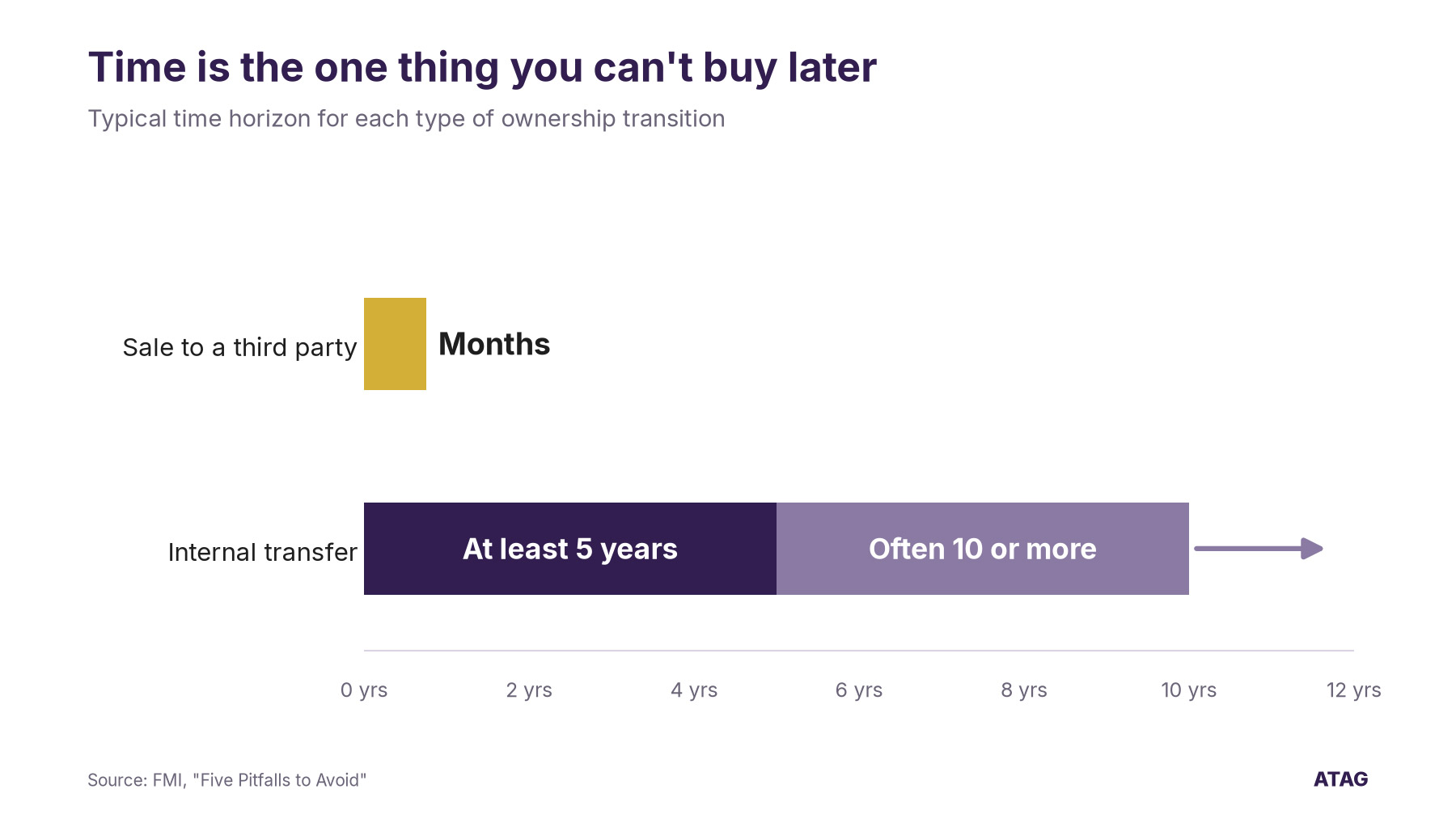
Architecture firms work the same way. FMI notes that a third-party sale can take months, while an internal transfer can take five to ten years or longer, and the seller must stay involved long enough to see it through. If you're 62 and just starting to think about this, some options may already be closed to you.
What's in a Name? Possibly Your Retirement.
Architects love putting their names on the door. It's understandable, since it's your work and your reputation. It's also one of the biggest obstacles to a clean transition. A buyer or successor has to ask how much of the firm's value depends on someone who's about to leave.
The industry's largest firms figured this out a long time ago. Hellmuth, Obata + Kassabaum is now simply HOK. Harwood K. Smith's 1939 Dallas practice became HKS. What was known as Howard, Needles, Tammen & Bergendoff in the 1940s has been HNTB since the 1990s.
There's a catch. Initials fix the succession problem and create a marketing problem. Ask a hospital board member or a developer to explain the difference between HOK, HKS, and HNTB, and you often get a polite smile. Outside the AEC world, three- or four-letter names starting with H, or any other letter, often blur together. Dropping your surname doesn't build a brand. It just removes the last thing people recognized.
The real fix is a brand that stands for something on its own: a market you own, a point of view, a way of working that clients can describe without mentioning the founder. That's marketing and branding strategy, and it does more than win the next project. It's one of the few things a principal can build now that directly increases what the firm is worth to the next owner.
The Paths Out
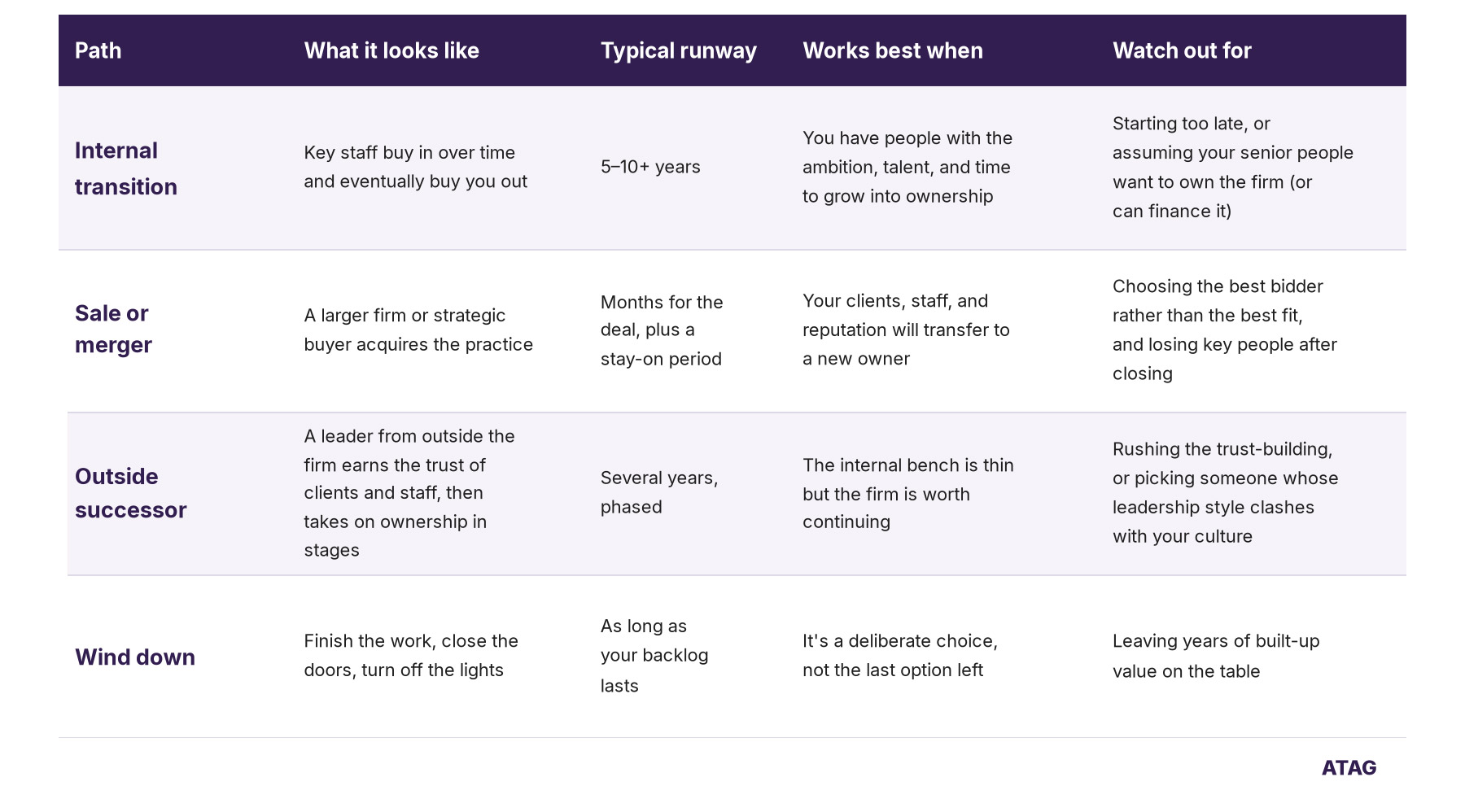
There are really only four ways to leave your firm ownership, and most principals have seriously considered only one.
What to Start Now, Even if You're Ten Years Out
Your M&A advisor, attorney, and CPA will handle valuation, deal structure, and tax. You need them, and none of this replaces them. Before they can help, though, the firm has to be something worth transferring. That part is strategy, and it starts years before anyone opens a spreadsheet.
Transfer your relationships before you transfer your shares. Bring a second person into every key client relationship now, and give them real responsibility, not just a seat at the meeting. If a client only returns your calls, that isn't loyalty. It's a sign of how much value could walk out the door with you.
Make the brand bigger than your name. A firm known for a point of view, a market expertise, or a way of working can outlast its founder. A firm known only as "Steve's place" usually can't.
Pick a successor for fit, not just financing. Whether the next leader is internal, a buyer, or someone from outside, ask how they'll lead your people, not just whether they can close. Then identify who is critical to keep, decide how you'll keep them, and be honest about who might work against the transition.
Decide what you actually want. That could be maximum value, protecting your people, preserving the firm's name, staying involved part-time, or some mix. The right path depends on the answer, and most principals have never written it down.
Build the team before you need it. Bring in a strategist to shape the plan and keep it moving, and line up the transaction professionals who will execute it. Interviewing M&A advisors in the same month you want to retire is like hiring a structural engineer after the steel has been ordered.
The Real Question
Every principal will leave their firm eventually. The only question is whether they leave on purpose.
Building a plan often shows the right successor has been in the building all along. Sometimes it shows they aren't, and the conversation turns to who could be. Either way, it's much better to find out at 55 than at 65.
If you've started to wonder what your firm looks like without you, that's a good conversation to have early. Reach out to ATAG.
Related Insights

The Client Already Has a Preferred Partner. Now What?
When a prospective client already has a trusted partner, pushing harder is not always the answer. Earning consideration starts with understanding what they value, demonstrating relevant expertise, and staying useful without becoming a nuisance. Explore how thoughtful, relationship-based business development can create opportunities—without requiring you to replace the incumbent.

Your CRM Should Help You Make Decisions, Not Just Store Contacts
A CRM should do more than store contacts and track proposals. It should help your firm make better decisions about relationships, pursuits, and future work. Explore how useful information, clear ownership, and consistent use can reveal where to improve, preserve institutional knowledge, and turn a database into a practical business development tool.

You Have a Marketing Coordinator, but Who is Setting the Strategy?
Your marketing coordinator puts together proposals, updates project sheets, chases résumés, and tries to keep the website current. If time remains, they might work on social media. Then several pursuits arrive at once, and everything else stops. The proposals go out....