
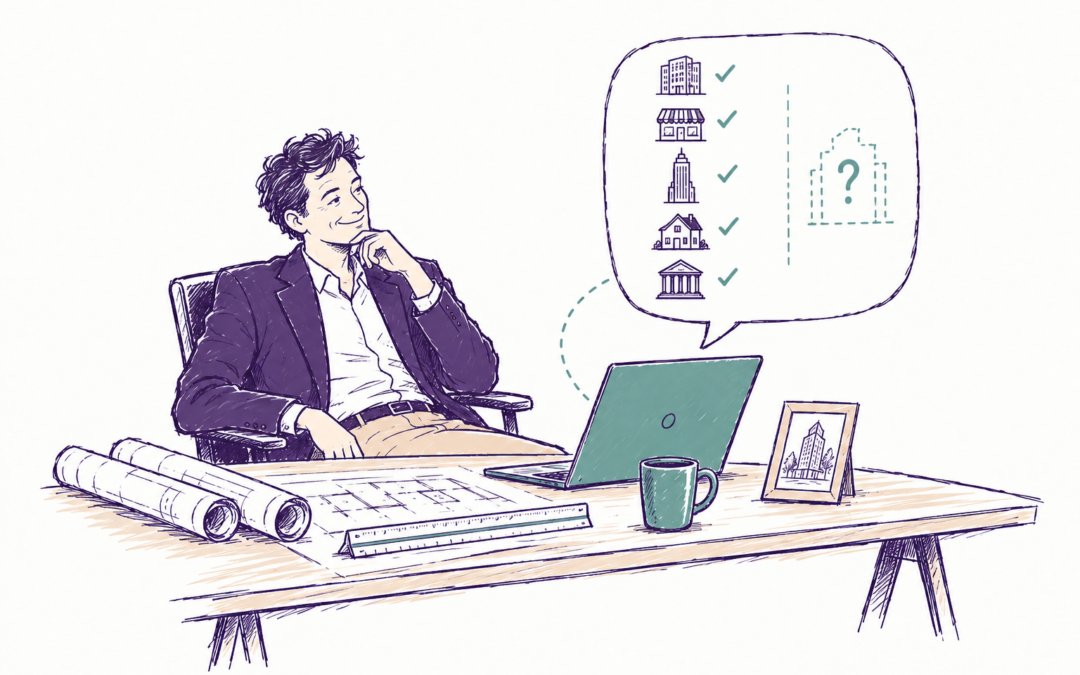
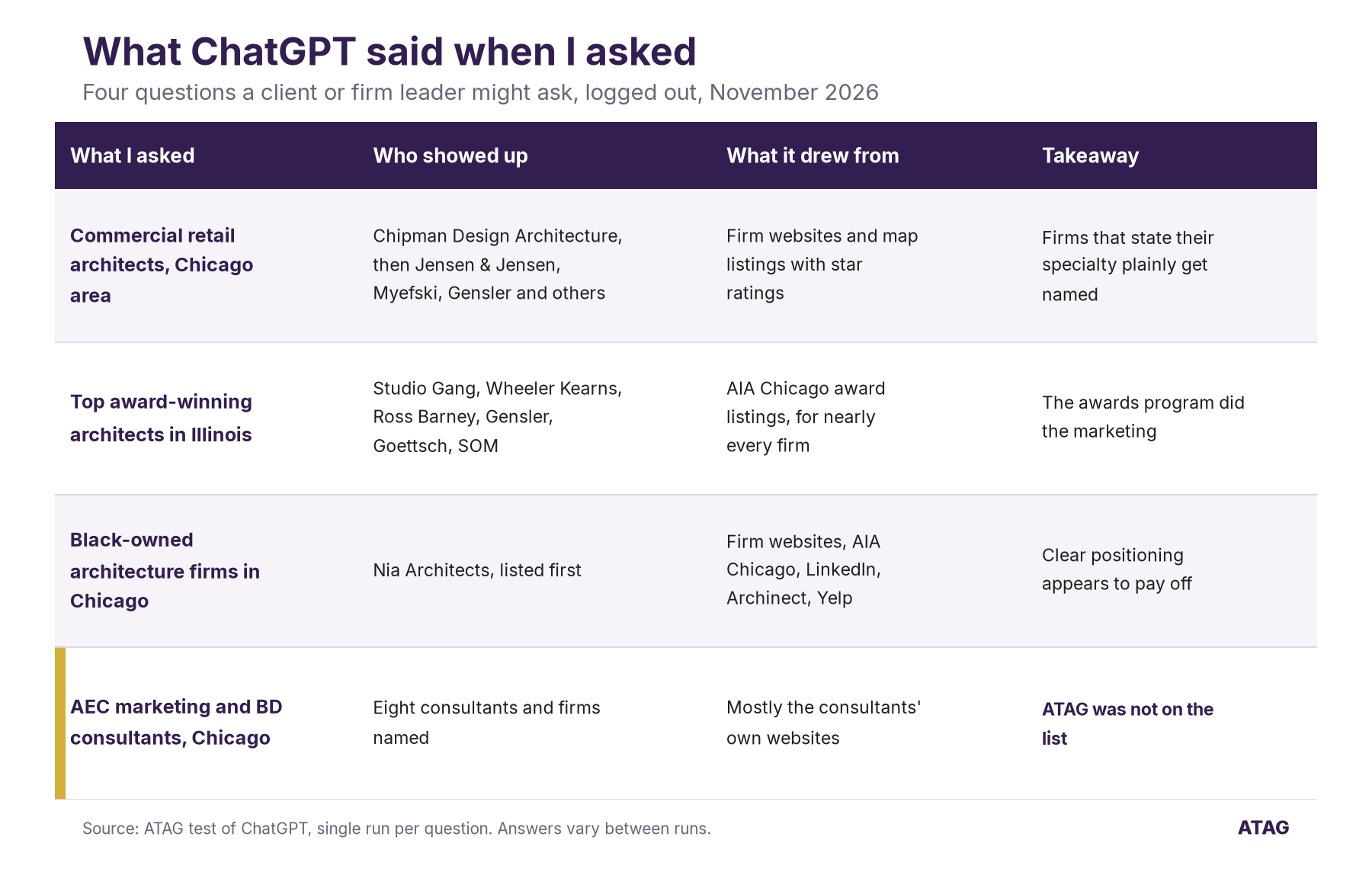
Last week I opened ChatGPT, logged out so my own history wouldn't tip the scales, and typed the question a Chicago firm owner might ask: "Who are good marketing and business development consultants for architecture firms in the Chicago area?"It gave me a confident, well-organized shortlist of eight firms and individuals, with backgrounds, specialties, and phone numbers. Several of them are people I respect. ATAG was not on the list.
The cobbler's kids don't have shoes, and apparently the marketing consultant's firm doesn't have AI visibility. In fairness to myself, there are reasons. ATAG is young, its website is younger, and since launch my attention has gone to client work rather than my own visibility. Search reputation takes time to build, and I haven't given it that time yet.
Those reasons are also the point. They're the same ones most firms would give, and they're the reason this piece exists: your firm is probably in the same position. The difference is you may not have checked.
Search Didn't Die. It Moved.
For decades, getting found online meant ranking on Google. You chose your keywords, built pages around them, earned some links, and tried to land on page one. I've been doing that work since around 2010, starting in manufacturing, where we sold CNC cutting machines and picked up an early advantage simply because our competitors weren't paying attention to search at all.
What's changing now is not whether people search. It's what they get back. More and more often, the answer is a written answer instead of a list of ten blue links: Google's AI Overviews and AI Mode, ChatGPT, Perplexity, Copilot, Gemini. The industry is calling the work of showing up in those answers generative engine optimization, or GEO, because the field never misses a chance to invent an acronym.
The effect on clicks is measurable. Pew Research found that people clicked on a result 8% of the time when Google showed an AI summary, compared with 15% when it didn't. Seer Interactive tracked thousands of queries and found that organic click-through on informational searches fell 61% when an AI Overview appeared. Seer's 2026 update suggests the decline has leveled off rather than reversed. It also found something more useful: brands cited inside the AI Overview got roughly twice the click-through of brands that weren't.
One clarification before anyone writes Google's obituary. Alphabet's search revenue grew 12% last quarter, to $63.35 billion, and the company reported its strongest search query growth in five years. The stock has fallen after earnings, partly over questions about how well AI Mode makes money. However, people are searching more than ever. They're just clicking less, and reading what the machine tells them.
For a professional services firm, that shift matters. When a developer asks an AI tool for a shortlist, the tool builds the shortlist. If you're not on it, you never get the chance to be compared.
What I Learned When it Worked
I'm not writing this as someone who has GEO solved. Nobody does yet, and anyone who says otherwise is selling something (usually a course). I'm writing as someone who has done search work for a long time and is now testing what carries over.
Here's one thing that did: At Nia Architects, a firm of less than ten people at the time, I incorporated SEO when I was redesigning the website for the firm nearly ten years ago. I did this in-house with no agency while also working as an Architect. Most minority-owned and community-focused firms weren't optimizing at all, because architecture websites tend to be built as portfolios: beautiful, image-heavy, and nearly unreadable for search engines. I focused on being clear about who the firm was and what it did. Nia ranked on Google's first page, and often at the top nationally, for searches like "community-focused architecture firm" and "Black-owned architecture firm."
As part of the same ChatGPT test, I asked: "What are some Black-owned architecture firms in Chicago?" Nia Architects came back first, cited to the firm's own website.
I want to be careful here. I can't prove that the earlier search work is why Nia leads that answer today. The firm has a long track record, certifications, and a real reputation, and all of those count. But it's a useful data point: the firm that made itself clearly legible to search engines years ago is the one the AI reads back now.
What the Machine Actually Reads
As part of my brief study for this article, I ran four queries in total, the kinds of questions an owner, developer, or firm leader might type:
- Architecture firms for commercial retail projects in the Chicago area
- Top award-winning architects in Illinois
- Black-owned architecture firms in Chicago
- Marketing and business development consultants for architecture firms in Chicago
The answers drew on a fairly predictable set of sources: firm websites, AIA Chicago award listings, LinkedIn, Archinect, Yelp, and map listings complete with star ratings. The award-winners answer cited AIA Chicago for nearly every firm it named, including Studio Gang, Wheeler Kearns, Ross Barney, Gensler, Goettsch Partners, and SOM. In other words, the awards program did the marketing.
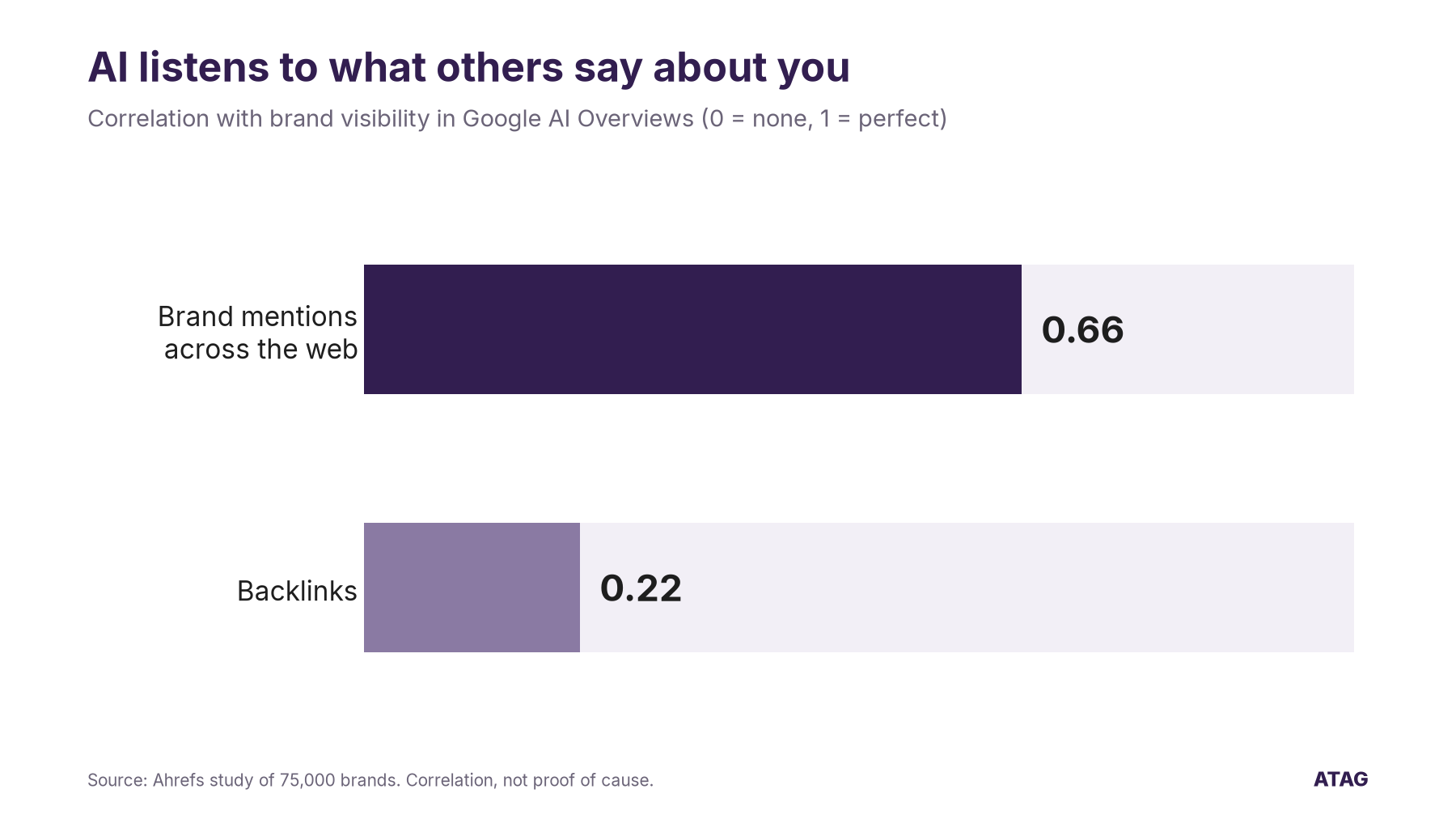
That lines up with the broader research. Ahrefs studied 75,000 brands and found that mentions of a brand across the web correlated far more strongly with AI Overview visibility (0.664) than backlinks did (0.218). Muck Rack's research found that most AI citations come from earned media, with paid content barely registering. These are correlations, not proof of cause, but the direction is consistent: AI tools lean heavily on what other people say about you.
For architects, that should feel familiar. It's reputation, just read by a machine. The awards submission you almost skipped, the conference talk, the trade publication feature, the project write-up a client posted, the directory profile nobody has updated since 2019: all of it is now raw material.
Three Things I'd Stop Believing
"If we rank on Google, the AI will find us." That used to be close to true. It's getting less true quickly. In mid-2025, Ahrefs found that about 76% of pages cited in Google's AI Overviews also ranked in the top ten for that search. By March 2026, the figure had fallen to about 38%. Outside Google, the link is weaker still: only about 8% of the sources ChatGPT cited in its answers ranked in Google's top ten for the same question. Ahrefs notes that part of the drop comes from changes in how it measured, but the direction is clear. The reason is that these tools no longer run just the question the client typed. They break it into many related searches and pull from all of them, so the page that ranks first for your keyword is now only one candidate among many.
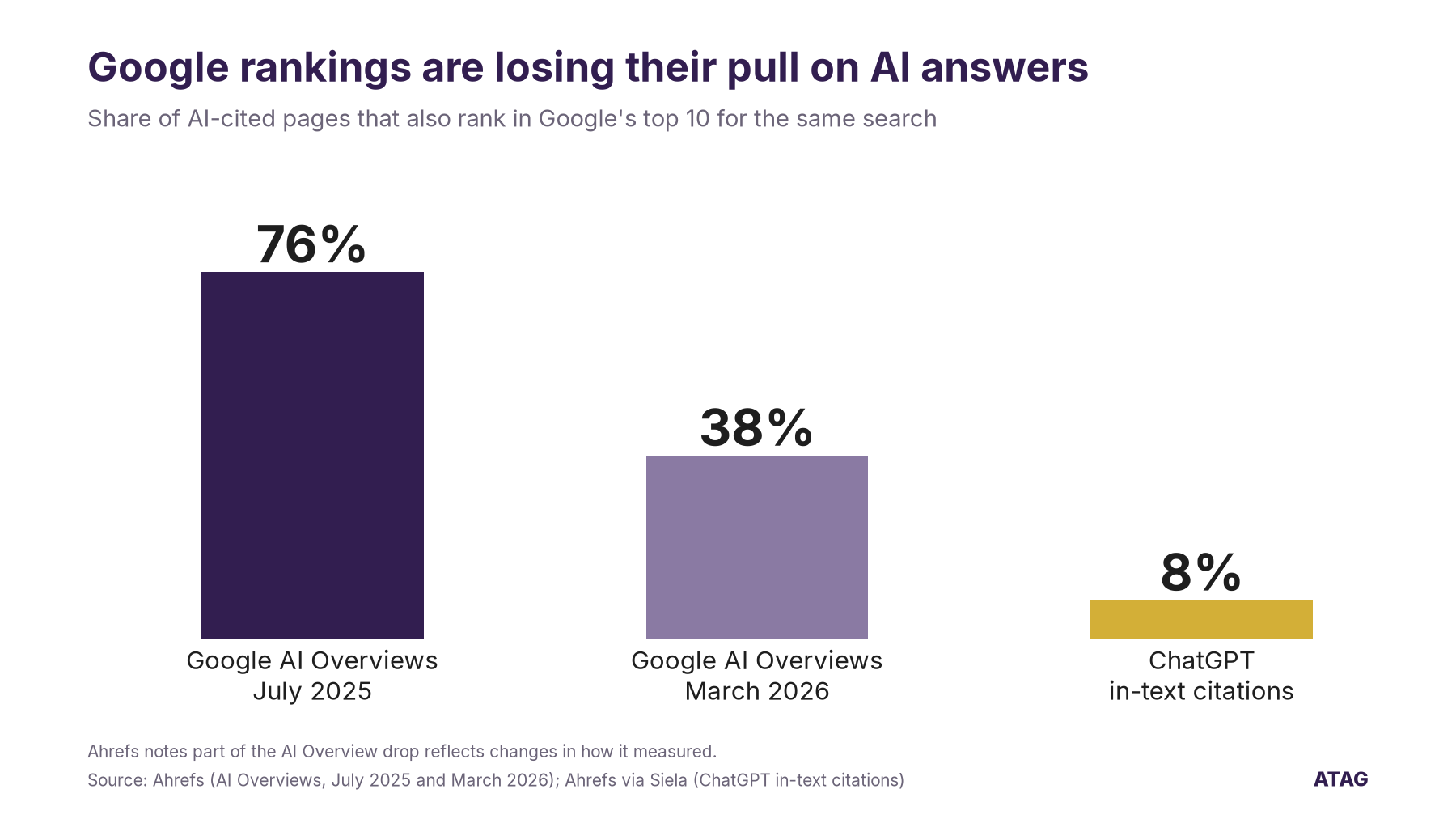
That doesn't make search work worthless. Pages ranking first on Google are still cited by ChatGPT 3.5 times as often as pages outside the top 20, according to AirOps. But a ranking is now an entry ticket, not a guarantee. The single-keyword landing pages I used to build, the kind that helped put Nia on page one, wouldn't be enough on their own today. What counts more and more is whether your firm shows up across the full range of questions a client might ask, and whether other people are talking about you.
"Add an FAQ page and some schema and you're done." I've read the same advice you have, and I haven't seen it proven. A recent academic study out of the University of Toronto of GEO found that many commonly recommended practices showed no measurable link to being cited. What did matter was closer to common sense: content that directly answers the questions people are actually asking.
"Pick a platform and optimize for it." This isn't Google circa 2012, where one company set the rules. It's an arms race with no clear winner. Another Ahrefs analysis found that only 14% of top cited domains overlapped across Google AI Overviews, ChatGPT, and Perplexity. Even how they credit you differs: Ahrefs found AI Overviews link to a brand they mention about 11% of the time, compared with about 52% for Perplexity. Chasing one tool's quirks is a good way to lose ground on the others.
Why This is an Opening for AEC Firms
Here's the uncomfortable part for our industry. Most AEC firms treat marketing as pursuits and proposals: respond to the RFP, polish the qualifications, win the interview. That work matters. But it starts after the client already knows you exist.
The website and the brand, the parts that generate interest before an RFP shows up, usually get far less attention. I've worked at large multinational firms whose websites did almost no search work. None of my clients have asked me about GEO. That isn't a sign it doesn't matter. It's a sign almost nobody in the industry is working on it yet.
That's what makes it an opportunity. When the competition isn't paying attention, small, steady effort goes a long way. I saw that in manufacturing in 2010 and again with Nia. And there's a reason to start early rather than wait: the University of Toronto study found that when a brand was already part of an AI model's existing knowledge, the model included it in its own searches 67% of the time, compared with 11% for brands it didn't already know. Visibility tends to compound. The firms these tools learn about first may be the ones they keep returning to.
A Note on Keeping the Human Part
I have mixed feelings about all this, and I think that's healthy. These tools use a lot of energy and water, and the industry hasn't fully reckoned with that. They also flatten things. An AI answer can tell a developer which firms do retail work in Chicago. It can't tell them which team will push back on a bad site plan, or which one will design something people actually want to walk into.
That's the point, though. AI is good at summarizing what's already out there. It doesn't create anything. Your job is to make sure what's out there about your firm is accurate, specific, and worth summarizing, so that when the shortlist gets built, the real work gets a chance to speak for itself.
Try it Yourself
Before you do anything else, run a quick test. Open two or three AI tools, log out, and ask the questions your best clients would ask. Leave your firm's name out. Ask for firms in your market, your project types, your city. Then look at who shows up, and what the tool cites to justify each name.
If your firm isn't there, you're in good company. Mine wasn't either. The difference is what you do next.
If you'd like help working out what these tools see when they look at your firm, and what to do about it, reach out to ATAG. I'll be fixing my own listing at the same time.
Related Insights

Locking the Door Is Not an Exit Strategy
Architects are trained to think in decades. We design buildings to stand for fifty years, master plans that run twenty, and maintenance strategies that outlast the original owner. Then many of us run our own firms as if the lease expires next Tuesday. Ask a principal...

The Client Already Has a Preferred Partner. Now What?
When a prospective client already has a trusted partner, pushing harder is not always the answer. Earning consideration starts with understanding what they value, demonstrating relevant expertise, and staying useful without becoming a nuisance. Explore how thoughtful, relationship-based business development can create opportunities—without requiring you to replace the incumbent.
Your CRM Should Help You Make Decisions, Not Just Store Contacts
A CRM should do more than store contacts and track proposals. It should help your firm make better decisions about relationships, pursuits, and future work. Explore how useful information, clear ownership, and consistent use can reveal where to improve, preserve institutional knowledge, and turn a database into a practical business development tool.